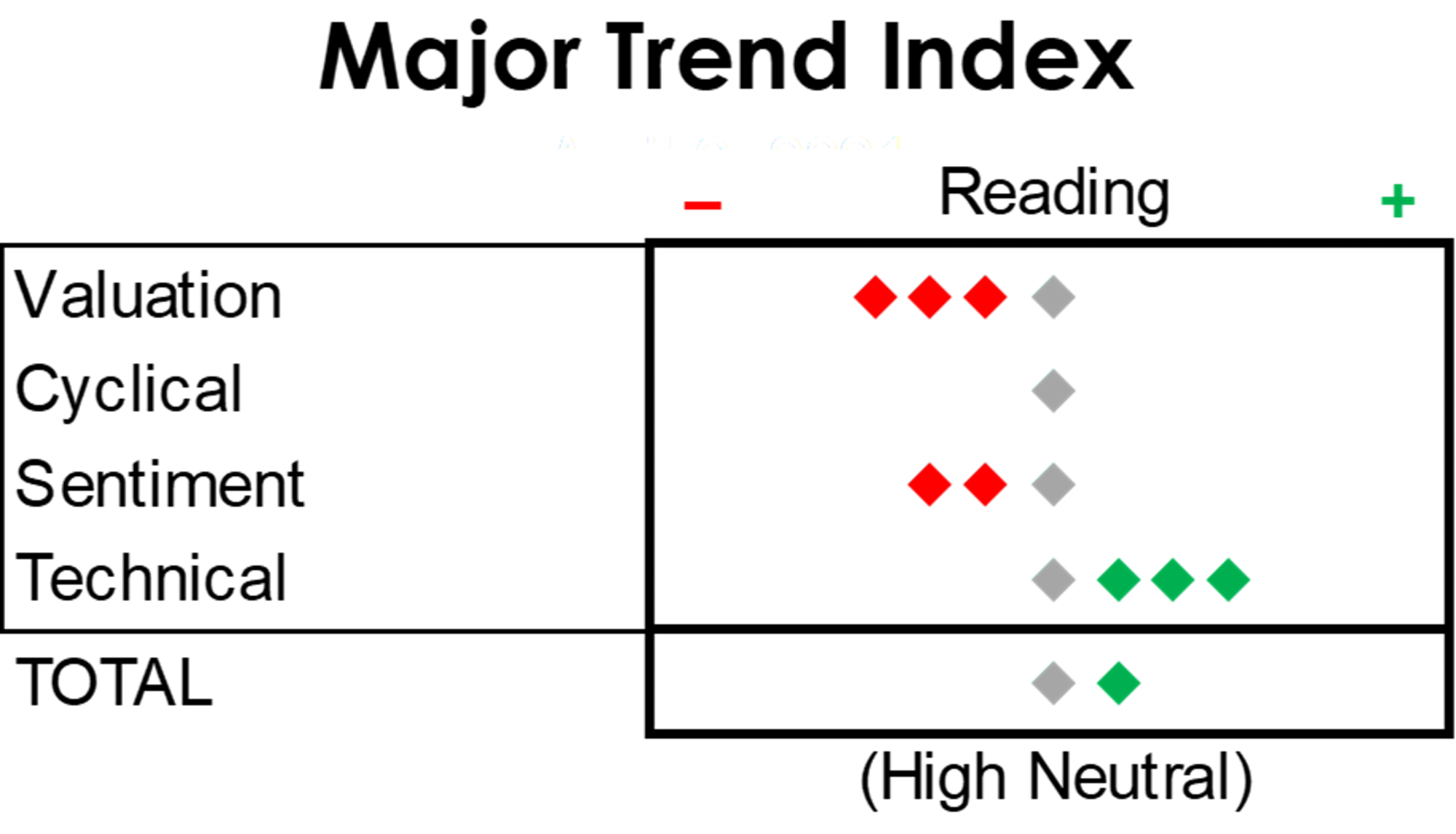
The S&P 500 ended last week hitting yet another all-time closing high, the fifth of the last eight trading sessions. Despite all those new highs, weekly returns for most major indexes were unremarkable for the first time in recent memory. That lack of “action” resulted in a significant drop in scoring updates across the MTI, which remains at High Neutral. Net equity exposure in Leuthold tactical accounts stands at 51%.
Within the relative calm of the market overall, semiconductors continued their incredible run. The PHLX Semiconductor Index ended Friday on an 18-day win streak, advancing 47% over that short period. It’s no wonder that within our Trend work, the indexes with outsized chip/AI exposure have been the few noticeable pockets of recent strength.
With such concentrated gains, overall market breadth continues to slide in our Technical category—the most notable dip being the S&P 500 Equal Weighted relative strength ratio. Since the bounce on March 30th, the average S&P 500 stock has advanced 7% compared to a 13% gain in the Cap Weighted index. The Equal Weighted index’s previously large YTD performance advantage—built up through March and cheered by active managers as a potential turning point—is now pretty much gone.
On the whole, we’d characterize the current Technical picture of the market as being very similar to the middle six months of 2025—Info Tech dominated and narrow. Thus, the S&P 500’s latest new high is much more in line with previous market tops, especially compared to the highs we saw this winter.
Friday’s new all-time high in the S&P 500 brought the bull market to an important milestone—a 100% price gain since its birth in October 2022. This doubling of the market is even more impressive considering the initial conditions 42 months ago: An economy near full employment and most long-term valuation measures for the index still in the top quintile of observations. (Our estimated “1957-to-date downside to the median” for that month read -27%.)
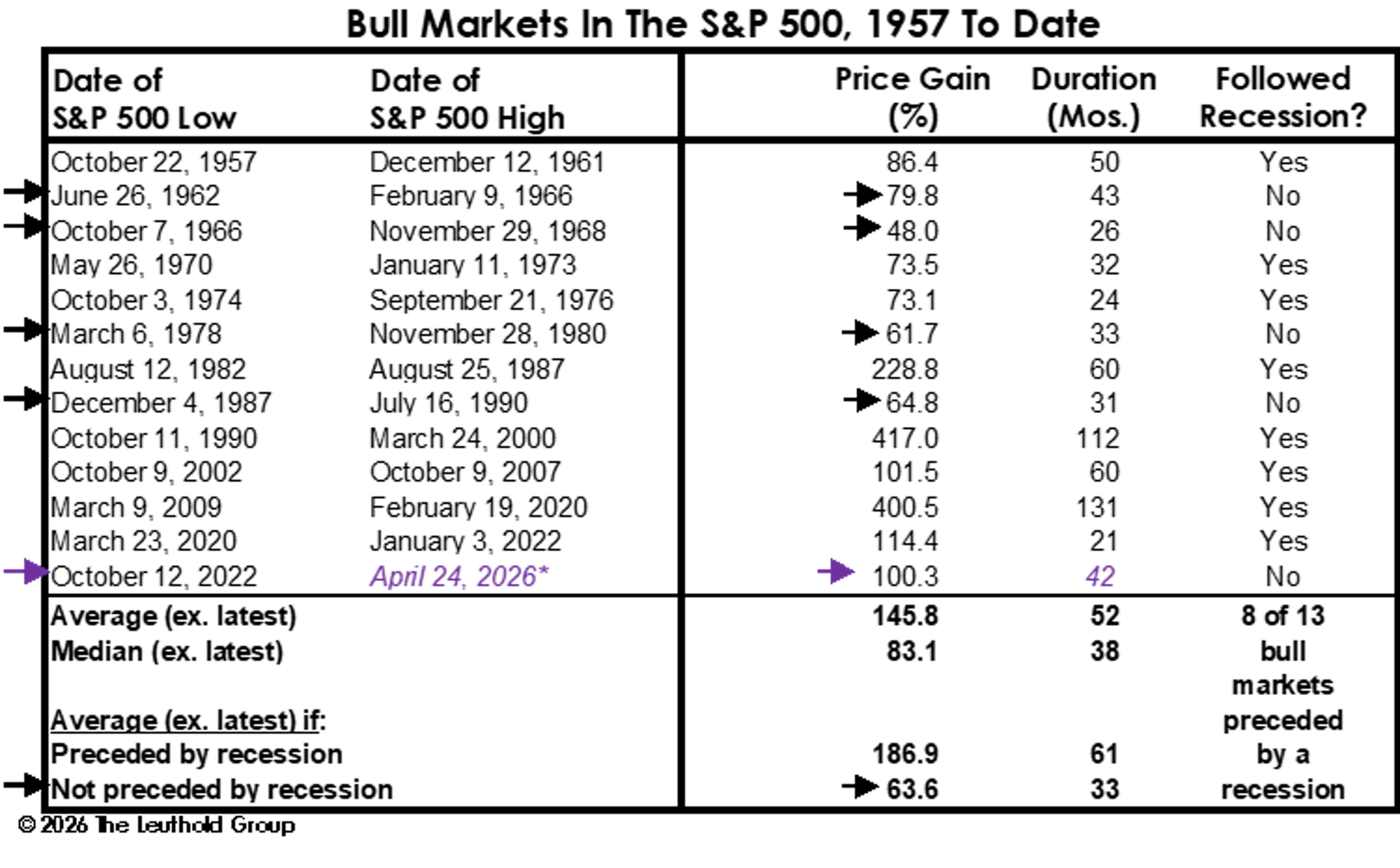
With no official recession in 2022, the current bull is horns, head and shoulders above all other bulls that followed non-recessionary bear markets. Also, if the S&P 500 continues to advance into the middle of June, it will be the longest-lived bull market not born with the “benefit” of a recession.
It’s safe to say that today’s bull has been an overachiever in many respects. Unfortunately, the same can’t be said for more democratic market indices. The bull market price gain to-date for the average S&P 500 stock is “only” +57%, while the S&P 600 stands at +52%.

 Subscribe to Advisor Newsletter